Total Pageviews

Copyright Theft

Copyright

All photographs are copyrighted.

Please do not copy or re-use without my WRITTEN permission.

Images published without consent is not permitted. I will procceed with court action on Copyright theft.

Copies maybe obtained upon request.

warshipsandauxiliares@yahoo.co.uk

Thank you

Thursday, 3 June 2010

HMS Sceptre

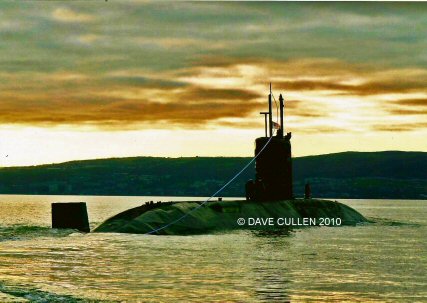
Following the return for the last time, HMS Sceptre arrived at Devonport (Plymouth) for the last time on Wednesday 25th May 2010.

HMS Sceptre entered port to the sound of the pipes for the final time on Wednesday 26th May after an eight month world-wide deployment and a distinguished 32-year career.  Since sailing from HM Naval Base Faslane in October 2009 she has been conducting training and exercises in the Indian Ocean and Atlantic and has now returned to Devonport Naval Base before decommissioning later in the year. 
Whilst on deployment Sceptre continuously trained to ensure she was ready to fight and win in any future conflict.  This included ensuring she was ready to fire her Tomahawk cruise missiles in case they were needed in support of current operations and taking part in anti-submarine warfare exercises with UK and our international partners’ naval and air forces.
During the 31,000 miles Sceptre covered on the deployment she visited South Africa, Turkey, the UAE and Portugal, building upon the stable and co-operative relationships the Royal Navy enjoys with all four countries.

This final deployment was typical of her role over the last decade, having also been around the world in 2003, 2004 and 2007.  Such work is a far cry from the Cold War role she was designed for in the 1970s.  She spent the 1970s and 1980s patrolling the North Atlantic, hunting for Soviet submarines.  Once the Cold War was over she spent much of the 1990s conducting training and trials with the US, working on joint US/UK submarine and anti-submarine tactics.

Sceptre’s Commanding Officer, Commander Steve Waller, said: “This is a sad day for the submarine community as HMS Sceptre, the last Swiftsure Class submarine still at sea, returns home for the last time.  However, we have signed off with a flourish having successfully completed a long and demanding worldwide deployment, contributing to the security and future prosperity of the UK.  My crew have lived up to the hard-working reputation of the Swiftsure Class, whilst Sceptre herself has proven how well submarines that began life as archetypal Cold War warriors have adapted to today’s needs”

Here are a few of my pics over the past few years...

During her refit in Rosyth in 2003


Seen here with HMS Spartan


Departing Rosyth dockyard 30 March 2003


A close up off her Conning Tower


And a few from a very recent trip on her from Gibraltar to Devonport

The ward room


The narrow bulkheads


Looking down from the Conning Tower


The steering controls and the main periscope in the foreground


The Ships Laundry (as a crew member said one setting only - Nuclear Inferno)


Junior Rates Mess


Aft Escape Area


Torpedo on the Torpedo Rack


The Torpedo Tube area aka Bomb Alley (this is where I slept for the three days I was on her recently)


Torpedo Tube (FLOODED AND LOADED!)


The Main Engine Control Area


Ships Crest and Badge


Ships Name


My sincere thanks to Commander Steve Waller and the crew for allowing me to join the ship (at Gibraltar) and sail with her on her final three days at sea, it was a fantastic experience, and I hope that you will like my images, off course many of the crew have already asked for images which they already have. 


Friday, 28 May 2010

Hms Spartan

Following the paying off of HMS Sceptre at Plymouth (on Wednesday 26 May 2010) there are no longer any S-Class (Swiftsure Class) in service.

I was lucky enough to get onboard a Police launch escorting HMS Spartan when she sailed from  HM Naval Base Clyde for the last time following 28 years of service with the Royal Navy (Wednesday 25th January 2006). Sailing out of the Gareloch with her 45 m decommissioning pennant blowing in the breeze Commander Paul Halton, the Captain of Spartan said: "It is sad leaving Faslane for the last time. Over the years the teams in the base have given us exceptional support to keep Spartan ready for operations and of course keeping the crew fed, watered and happy when alongside." 


Prior to her last sailing, and as is traditional in the Navy, a decommissioning ceremony was held on 20th January to mark the successful completion of her service and to thank the men who have served in the Swiftsure Class Submarine over the years. Guest of honour at the ceremony was former First Sea Lord Admiral Sir Raymond Lygo, KCB who's late wife, Lady Emily Lygo, was the boat's Sponsor having originally named and launched her in 1978. 

Spartan
Spartan's last patrol was one of the most successful yet, having completed a five month long global deployment which saw her cover some 30,000 miles, transit three oceans and visit four continents before returning home just in time for Christmas 2005.


Friday, 23 April 2010

Fs Marne

The Marne is the fourth of five Durance class replenishment oiler, originally designed and built for service in the French Navy.  Besides the five ships built for the French Navy, a sixth was built for the Royal Australian Navy  (Hmas Success AOR 304) and the leading ship of the class Durance now serves with the Argentine Navy under the name Patagonia.
Five ships of the class were built for the French Navy:

Durance (A629), Meuse (A607), Var (A608), Marne (A630) and Somme (A631)

In French service, the ships are dubbed Bâtiment de commandement et ravitailleur (BCR, "command and replenishment ship"): in addition to their role as a fleet tanker, than can harbour an entire general staff and supervise naval operations.
Three ships of the class (the Marne, the Somme and the Var) are fitted out as flagships and can embark and an admiral and his staff. 

In October 2009, the Somme repelled an attack by Somali pirates. 

She is seen here arriving Leith (around 08:30am) today 23 April 2010


Seen here coming on to the Ocean Terminal Berth quite some time later, I think the Pilot was new


Also seen doing their excellent work tying up the ships (with no golf clubs in sight) are the Leith Boatmen. 

Fs Latouche Tréville


Latouche Tréville is a George Leygues class and she is a F70 type anti-submarine frigate of the French Marine Nationale.  They are polyvalent (multi-role), due to their Exocet and Crotale missle complement, making them especially suitable for defense of strategic positions, demonstrations, or highseas escorts.

The superstructures were built as to optimise resistance against nuclear explosion blasts.
The F70 is internationally labelled an "anti-submarine destroyer" (hence the "D" in the hull numbers), though the French don't use the term and refer to the ships as "frigates".

The last three ships of the class had their bridges raised one deck to overcome problems experienced by the first four in bad weather, as well as being equipped with DSBV 61 passive linear towed array sonar and several other upgraded systems.

The Cassard class AA frigates are an air defence variant of the Georges Leygues class.

Latouche Tréville is the third French vessel named after the 19th century politician and admiral Louis René Levassor de Latouche Tréville.  

She is seen here arriving in Leith early today (around 06:45am!) 23 April 2010