Total Pageviews

Copyright Theft

Copyright

All photographs are copyrighted.

Please do not copy or re-use without my WRITTEN permission.

Images published without consent is not permitted. I will procceed with court action on Copyright theft.

Copies maybe obtained upon request.

warshipsandauxiliares@yahoo.co.uk

Thank you

Wednesday, 18 August 2010

Rubis class submarine

The Rubis type is a class of first-generation nuclear attack submarines of the French Navy. They are the most compact nuclear attack submarines to date.
All submarines of the class (except for Casabianca) are named after gemstones.

Although the Rubis belonged to the same generation as the Redoutable class, due to President Charles De Gaulle insistence on acquiring a nuclear deterrent for France, the program was started only in 1974, after the SSBN program. The first of class Rubis was laid down in December 1976 and launched in 1979.
In 1987, the Canadian White Paper on Defence recommended the purchase of 10 to 12 Rubis or Trafalgar class submarines under technology transfered with the choice of the type of submarine due to be confirmed before Summer 1988The goal was to build up a three-ocean navy and to assert Canadian sovereignty over Arctic waters.  The purchase was finally abandoned in April 1989.

Ships of the class
S601 Rubis (ex-Provence)
S602 Saphir (ex-Bretagne)
S603 Casabianca (ex-Bourgogne)
S604 Émeraude
S605 Améthyste
S606 Perle

FS Saphir is seen here at Faslane


FS Dupleix

The Dupleix is a F70 type anti-submarine frigate of the French Marine Nationale. She is the fourth French vessel (beside also two French commercial ships) named after the XVIIIth Century Governor of Pondichéry and Gouverneur Général of the French possessions in India marquess Joseph François Dupleix.

Note: The French navy doesn't use the term "destroyer" for its ships; hence some large ships, referred to as "frigates", are registered as destroyers.

She is seen here alongside in Leith (on the inside) of the Spanish Baleares class frigate Andalucia


Walchensee class tanker

The Type 703 Walchensee class tanker are small coastal tankers used by the German Navy to transport fuel and fresh water between depots and to units near coasts or in harbour.

Only two of the class remain in service

Ships of the class
A 1425 Ammersee
A 1426 Tegernsee

Fgs Tegernsee is seen here departing Faslane


Rhön Class Tanker

The Type 704A Rhön class tankers are replenishment oiler used by the German Navy to provide underway replenishment for its ships at sea.

Ships of the class
A 1442 Spessart
A 1443 Rhön
Originally the ships were built for Libya as Okene (Rhön) and Okapi (Spessart). Rhön and Spessart are names of forests (small mountain ranges) in Germany.

Spessart was originally built for civilian service by Kröger of Rendsburg in 1974. On 5 September 1977 she was commissioned into the Deutsche Marine, based at Keil.

On 29 March 2009, as she was taking part in Operation Atalanta, Spessart was attacked by a 7-man pirate boatIn addition to the regular 40-man civilian crew, Spessart carried a 12-man security detail which exchanged small arm fire with the pirates, and repelled the assault.  The frigates HrMs De Zeven Provinciën, HS Psara, SPS Victoria and the USS Boxer intervened and captured the pirates after a few hours of chase.

Fgs Rhön is seen here arriving at Leith


Oste Class Fleet Service Ship

Officially designated as fleet service ships, the three vessels of the Type 423 Oste class are purpose built SIGINT/ELINT and reconnaissance ships of the German Navy. They replaced the Type 422 class.

Accommodation for the crew was designed to civil standards, and the Oste class offers much more comfort for the crew than other ships in the German Navy.

Ships of the class
A 50 Alster
A 52 Oste
A 53 Oker
The ships were built at Flensburger Schiffbau-Gesellschaft in Flensburg.
All ships are currently based in Eckernförde and belong to the 1st submarine squadron stationed in Eckernförde. The vessels got the same name and pennant numbers as the three Type 422 class vessels they replaced. To avoid the confusion, the ship names are sometimes suffixed with II.

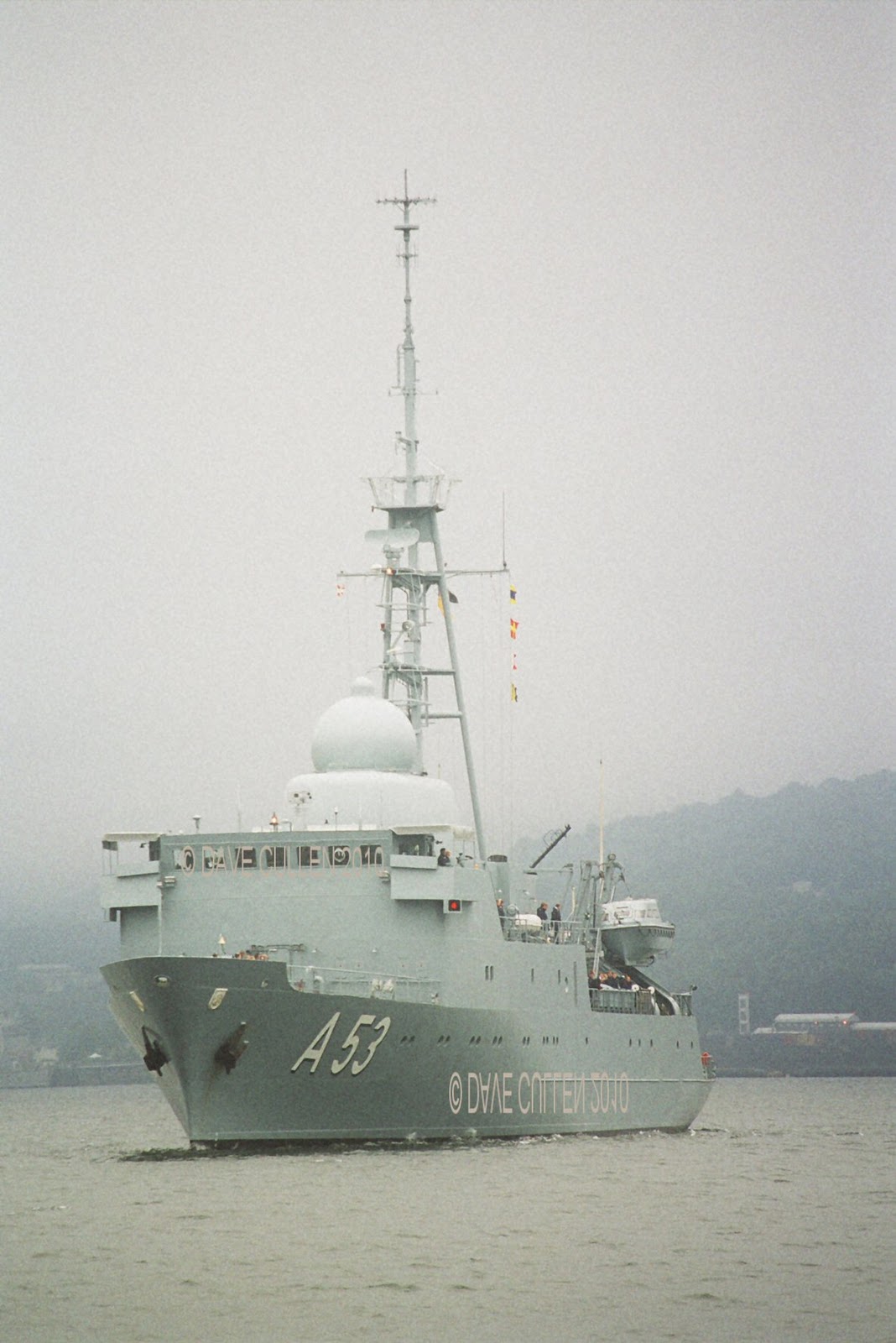
The Oker is an intelligence ship of the German Navy. She is the lead ship of the German Navy's Type 423.
The Oker is meant as a reconnaissance ship, with a wide array of modern elektromagnetic, hydroacoustic and electro-optic sensors for strategic intelligence gathering. She can be used as an advanced warning unit. The design was originally intended to gather data on Soviet ships.

The Oker is seen here departing Faslane


Elbe Class Replenishment Ship

The Type 404 Elbe class replenishment ships of the German Navy were built to support its squadrons of Fast Attack Craft, submarines and minesweeper/hunters, as such they are usually referred to as tenders.

The ships carry fuel, fresh water, food, ammunition and other matériel. They also have a medical station aboard but doctors are not part of their standard complement and will have to be flown in. The tender also manage waste disposal for the ships they support at sea and can carry out minor repairs of assigned ships. For this purpose Elbe class tenders assigned to FAC squadrons, for example, carry the SUG repair and support shop specialized for these boats on their deck in a set of 13 standard containers.

Extensive communication gear and accommodations enable them to serve as squadron flagship.  While in general all Elbe class tenders are quickly configurable to be reassigned to support other squadrons, one of the six ships is usually modified to support German submarines - carrying batteries for reloading for example. This ship - currently A515 Main - while still being of the same class, and easily reconfigurable - is often named as a separate "sub-class" due to this larger modification.  The ships are all named after German rivers

Ships of the class
A 511 Elbe
A 512 Mosel
A 513 Rhein
A 514 Werra
A 515 Main
A 516 Donau

Fgs Elbe is seen here departing Faslane with her chicks in the background


A few days later she is alongside in Leith

Fgs Dattelin

Fgs Dattelin is a Type 332 Frankenthal class mine hunter iand is in a class of German mine hunters. The ship is re built of non-magnetic steel. Hull, machinery and superstructure of this class is similar to the original Type 343 Hameln class minesweeper, but the equipment differs.

Slightly modified Frankenthal class mine hunters are also operated by the Turkish Navy, where they are referred to as the A Class.

All active ships are currently stationed in Kiel at the Baltic Sea. As the German Navy closed the naval base at Olpenitz, all ships were relocated to Kiel and their squadrons incorporated into the Einsatzflottille 1 (Flotilla 1).

On 21 February 2007, her sister Grömitz ran onto a reef in the Floro fjord while on tour in western Norway and remained stranded in a spectacular way until being salvaged.


She is seen here sailing down the Firth of Clyde with the Belgian Minesweeper Bellis

Gepard Class Fast Attack Craft

The Type 143A Gepard class is Germany's last class of missile bearing fast attack craft (Schnellboot in German) and the only one still in service with the German Navy since 1990.

It is an evolution of the Type 143 Albatros class. It is planned that Gepard class vessels will gradually be supplemented by Braunschweig class corvettes from 2008 on and to be replaced by a new class of corvettes around 2015.

The class is named after small, wild animals often of a ferocious nature named respectively cheetah, puma, stoat, mink, marten, ferret, badger, wildcat, weasel and hyena.

Ships of the class

P6121 S 71 Gepard
P6122 S 72 Puma
P6123 S 73 Hermelin
P6124 S 74 Nerz
P6125 S 75 Zobel
P6126 S 76 Frettchen
P6127 S 77 Dachs
P6128 S 78 Ozelot
P6129 S 79 Wiesel
P6130 S 80 Hyäne

The "S" and the number are part of the ship's full name. When the ships were first commissioned, their designation included only the number; however, the crews petitioned for full names, and the decision was made to combine the original names with the additional animal name.

Since 1 July 2006, all ships are part of the 7. Schnellbootgeschwader (7th Fast Patrol Boat Squadron), whereas for the 8 years prior the flotilla was split into (hulls S 76—S 80) 2. Schnellbootgeschwader (2nd Fast Patrol Boat Squadron), and a smaller (hulls S 71—S 75) 7. Schnellbootgeschwader. The squadron is stationed in Warnemünde, where both predecessor squadrons were also based.

Fgs Dachs is seen here departing Faslane


Fgs  Hyäne is seen here departing Faslane the same day


Saturday, 14 August 2010

Bremen Class Frigates

The eight F122 Bremen class frigates of the German Navy have been commissioned between 1982 and 1990. The design is similar to the Dutch Kortenaer class but uses a different hull and propulsion system. The ships were built for anti-submarine warfare as primary task even though they are not fitted with towed array sonars. They are also suited for anti-aircraft warfare and anti-surface warfare.

This class of ship was one of the last to be constructed under post-war displacement limitations imposed by the WEU on West Germany.

The four oldest Bremen class frigates will be replaced by the planned F125 class frigates, starting probably around 2014. Until then they will serve as the backbone of the German Navy.

During the Cold War period, the ships' main war task was to escort convoys for reinforcement and resupply of Allied forces in Europe. They frequently took part in NATO Standing Naval Forces. Since 1990, all ships have served in additional supporting missions such as the embargo operations against former Yugoslavia in the Adriatic Sea or Operation Enduring Freedom against the international terrorism.

During their lifetime, the ships' equipment has frequently been modernised and a further adaptation of combat systems is foreseen in near future.

The Karlsruhe successfully assisted an Egyptian freighter repel pirates on December 25, 2008 in the Gulf of Aden.

Ships of the class
F207 Bremen
F208 Niedersachsen

F209 Rheinland-Pfalz


F210 Emden
F211 Köln
F212 Karlsruhe


F213 Augsburg
F214 Lübeck


All ships are based in Wilhelmshaven. Together they form the 4. Fregattengeschwader (4th Frigate Squadron) of the German Navy.

Fgs Bremen is seen here in Leith


Fgs Niedersachsen is seen here approaching Leith


Coming through the locks


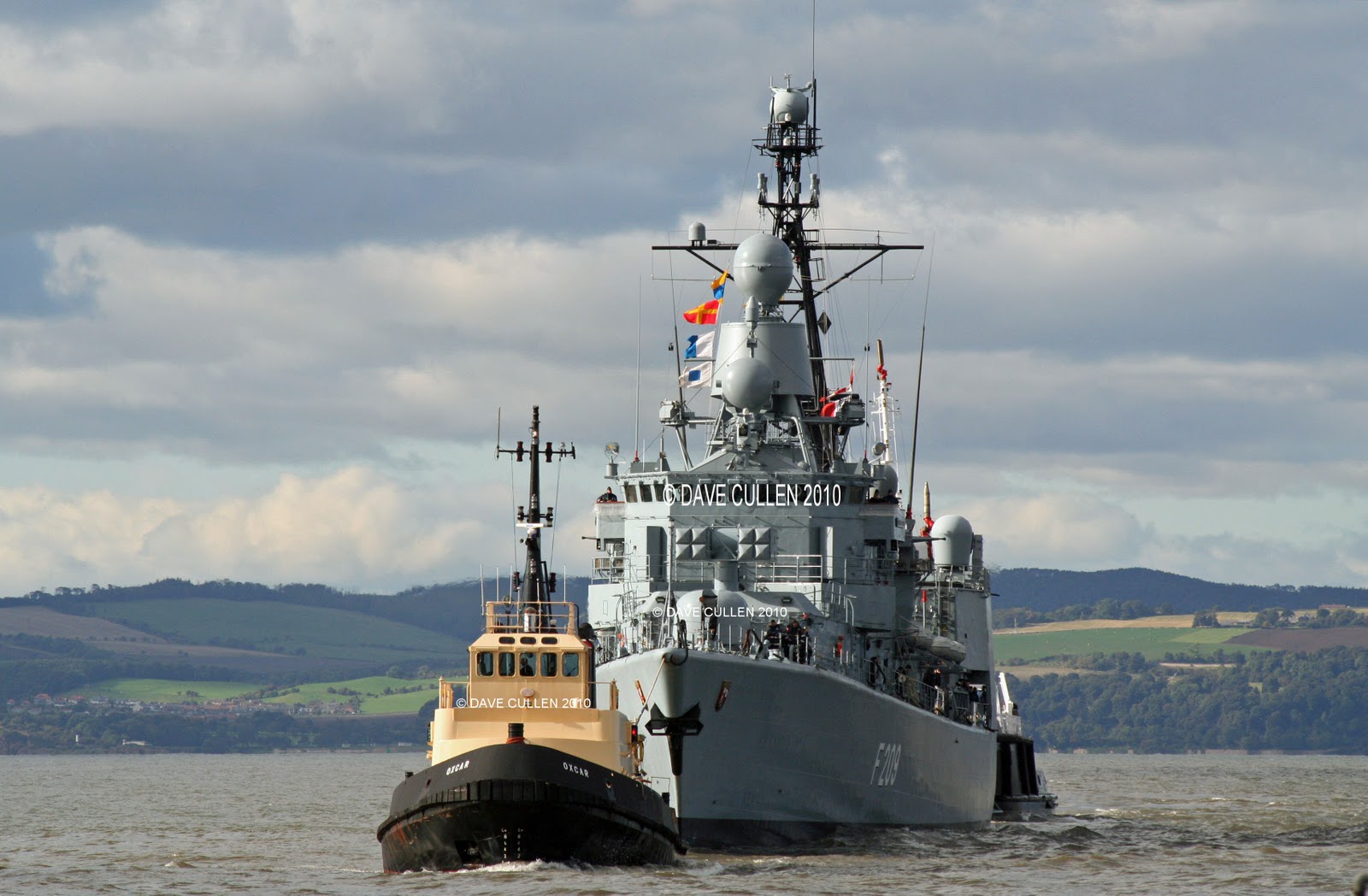
Fgs Rheinland Pfalz seen here arriving at Leith on Friday 27 September 2010


Approaching the lock entrance


Entering the lock


Triparte Class Minehunters

The Tripartite class is a class of mine warfare vessel used by the navies of Belgium, France and the Netherlands, as well as Pakistan, Indonesia, Latvia, and Bulgaria.

A joint venture of the navies of France, Belgium, and the Netherlands, the Tripartite class of minehunters were conceived in the 1970s and built in the 1980s. France built the mine-hunting equipment, Belgium provided the electronics, and the Netherlands constructed the propulsion train. France and the Netherlands originally bought 15, with Belgium buying 10.

All three countries' Tripartite ships contribute at times to NATO's Standing Maritime MCM capability groups (SNMCMG1 or SNMCMG2).

Ships of the class

Belgium

M915 Aster
M916 Bellis
M917 Crocus
M921 Lobelia
M923 Narcis
M924 Primula

Netherlands
M850 Alkmaar (no longer in service, sold to Latvia)
M851 Delfzijl (no longer in service, sold to Latvia)
M852 Dordrecht (no longer in service, sold to Latvia)
M853 Haarlem
M854 Harlingen (no longer in service, sold to Latvia)
M855 Scheveningen (no longer in service, sold to Latvia)
M856 Maasluis
M857 Makkum
M858 Middelburg
M859 Hellevoetsluis
M860 Schiedam
M861 Urk
M862 Zierikzee
M863 Vlaardingen
M864 Willemstad

Here is BNS Aster arriving in Leith


BNS Bellis sailing down the Clyde


HrMs Willemstad sailing down the Firth of Clyde


And arriving in Leith a few days later