Total Pageviews

Copyright Theft

Copyright

All photographs are copyrighted.

Please do not copy or re-use without my WRITTEN permission.

Images published without consent is not permitted. I will procceed with court action on Copyright theft.

Copies maybe obtained upon request.

warshipsandauxiliares@yahoo.co.uk

Thank you

Showing posts with label Royal Fleet Auxiliary. Show all posts

Saturday, 28 August 2010

RFA Argus

RFA Argus (A135) is an aviation training ship with a secondary role of primary casualty receiving ship in the Royal Fleet Auxiliary. Italian-built, Argus was formerly the container ship MV Contender Bezant. The ship was requisitioned in 1982 for service in the Falklands War and purchased outright in 1984.

After a four year conversion at Harland and Wolff in Belfast the ship entered RFA service in 1988. Having been initially designed as a container ship, her stability when unloaded would be excessive making her motion at sea uncomfortable or even dangerous. Therefore, her superstructure is deliberately heavily built (weighing some 800 tons), and she has 1,800 tons of concrete ballast carried in former hatch covers, which have been inverted to form tray-like structures

Being a former container ship, Argus does not have a traditional aircraft carrier layout - the ship's superstructure is located forward, with a long flight deck aft. The ship has a small secondary superstructure approximately 2/3 of the way down the flight deck, containing the ship's exhaust funnel. This is used by small helicopters to simulate landing on the flight deck of a destroyer or frigate.

Argus was fitted with a fully functional hospital for the 1991 Gulf crisis, which has since been added to, providing 100 beds. It is equipped with the best of equipment: x-ray facilities, CAT scanner, ITU ward etc. Casualties can be quickly transferred from the deck directly into the assessment area. In recent conflicts, the ship's role as a Primary Casualty Receiving Ship (referred to as such rather than a hospital ship as the vessel is armed, thus not meeting the Geneva Convention definition of a hospital ship) has been more prominent than its aviation training duties.

In 2007 the ship was refitted with upgraded hospital facilities (replacing the forward aircraft lift with a ramp for emergency exit for hospital trollies and patients as well as two 50-man passenger lifts that lead to a new structure erected on the flight deck), generators and aviation systems (the ship is due to receive an upgrade to its night-vision capabilities enabling the use of AH-64 Apache helicopters) to give an operational life until 2020.

Argus entered service with the RFA in 1988, replacing RFA Engadine in the aviation training role. The ship deployed to the Persian Gulf in 1991 for service in the Gulf War, and also saw service in the Adriatic in 1993 and 1999 supporting British operations in Bosnia and over Kosovo respectively. During this period, Argus LPH. Her unsuitability for this role was a major factor in the commissioning of HMS Ocean. In 2003 Argus was deployed again to the Gulf as part of a 33 ship fleet to support a British amphibious assault of the Peninsula. Argus operated in its PCRS role.

In 2008 she deployed to the Middle East to act as a platform for Sea King ASaCs7 helicopters.  A program to replace Argus called the Joint Casualty Treatment Ship (JCTS) was put on hold in December 2001 after passing initial approval. The Integrated Project Team (IPT) managing the project was subsequently disbanded in 2005.

The ship was most recently stationed in's home port is Falmouth in Cornwall England England although being an RFA ship means that she also uses the former naval dockyard in Portland in Dorse.

During times of war RFA Argus acts as a floating hospital with two full wards and mortuary. The last time the hospital was utilised in this way was off the coast of Freetown in 2000-01, in support of British operations against the rebel West Side Boys.

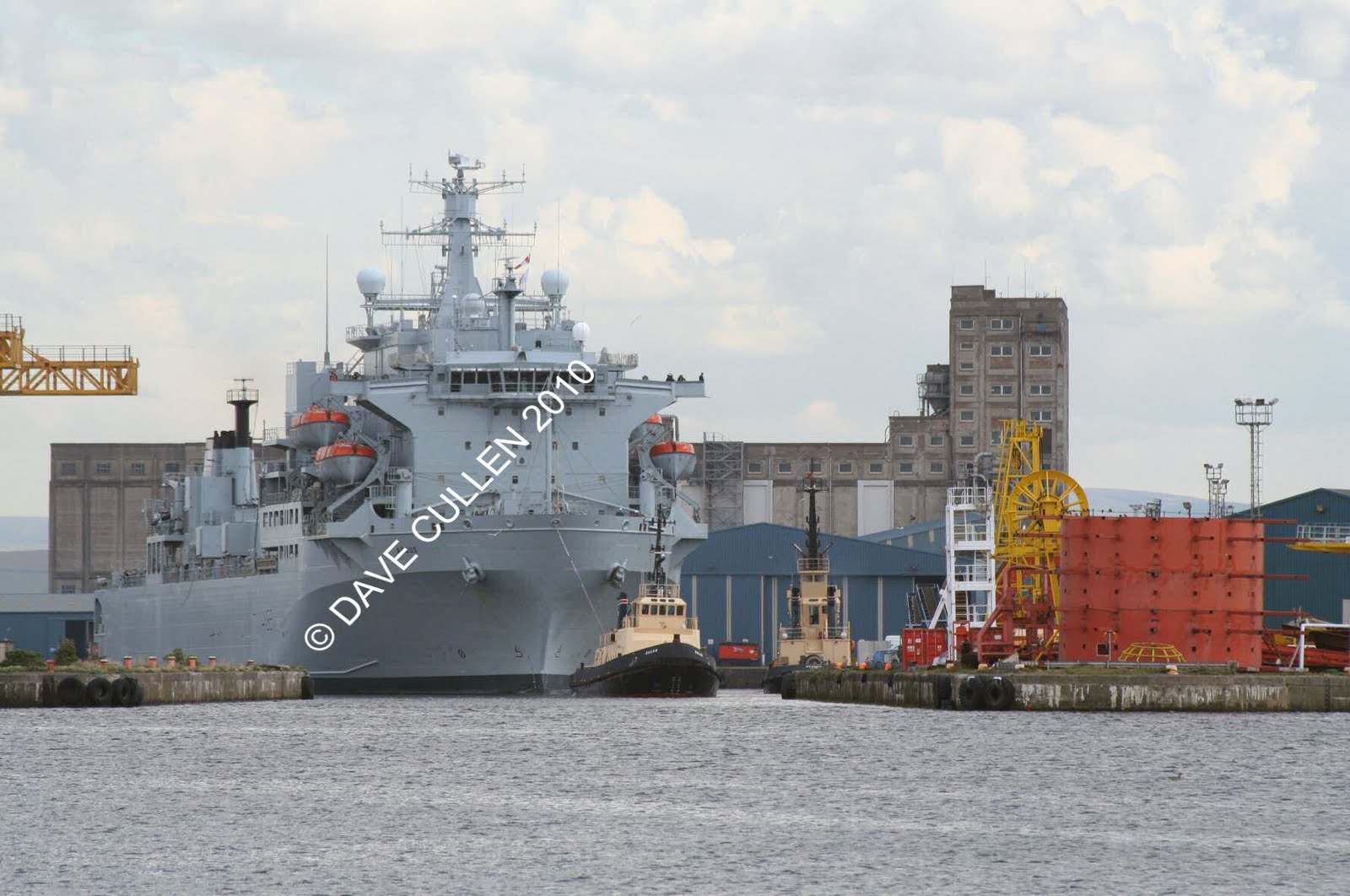
She is seen arriving in Sunday 16th August 2010 after her recent £37million pound refit.


Approaching the lock entrance


A tight squeeze as she enters the lock


Sitting in the locks waiting for the levels to equalise


Safely through the lock making her way (slowly) to the Imperial Dock


Passing through the very narrow Imperial Dock entrance


Through the entrance making her way to her berth


Finally on her berth


The view from her bridge


Main engine controls


CT Scanner


The operating theatre


The HDU (High Dependancy Unit)


Entrance to the hospital via the flight deck


Down the ramp and into the hospital


The ship's four diesel generators


This is the hangar deck capable of holding 4 Sea King helicopters


The flight deck towards the ship


Looking at the flight deck from the superstructure


She is seen here departing Leith 27 August 2010 after her 11 day stay

Coming through the cut at the Imperial Dock


Look at how tight it is coming through the cut


Finally on her way to the locks


Safely in the locks


On her way back to open water


Monday, 23 August 2010

RFA Lyme Bay

RFA Lyme Bay (L3007) is a Bay class auxiliary landing ship dock (LSD(A)) of the British Royal Fleet Auxiliary.

Lyme Bay was built by Swan Hunter at Wallsend on the River Tyne, being the last ship built on the river. On July 13, 2006 it was announced that, due to delays and cost over-runs, fitting out of Lyme Bay would be transferred from Swan Hunter and completed by BAE Systems at Scotstoun. Lyme Bay arrived on the River Clyde on July 22, 2006.

RFA Lyme Bay is seen here fitting out at Scotstoun


Saturday, 7 August 2010

RFA Largs Bay

RFA Largs Bay (L3006) is a Bay class landing ship dock of the Royal Fleet Auxiliary (RFA), built by Swan Hunter in Wallsend, Tyne and Wear. She is named for Largs Bay in Ayrshire, Scotland.


The Bay class are based on the Royal Schelde Enforcer design, similar to Dutch HrMs Rotterdam (L800) and Spanish SPS Galicia (L51) LPDs. They were at first classified as Alternative Landing Ship Logistics Round Table class Landing Ship (Logistics). However, they have been reclassified as (ALSL), to replace the Landing Ship Dock (Auxiliary) (LSD(A)), as they developed into a form very much more like an LSD, with a large flight deck aft and a docking well in the stern capable of operating a LCU Mk 10. The large flight deck can accommodate two Merlin or Chinook helicopters. The military lift includes the capacity to load and transport up to 32 Challenger 2 tanks, or 150 light trucks. They can carry a normal load of 356 troops, or overloaded with 500. They are designed to operate Over the horizon using helicopters and landing craft, to get men and equipment ashore.

Largs Bay and Lyme Bay were built by Swan Hunter on the River Tyne at the Wallsend shipyard, whilst Mounts Bay and Cardigan Bay were built by BAE Systems Naval Ships at Govan on the River Clyde. On 13 July 2006 it was announced that, due to delays and cost over-runs, fitting out of Lyme Bay would be transferred to BAE Systems Naval Ships at Scotstoun.  Lyme Bay arrived on the Clyde on July 22, 2006.  The vessels were not conventionally launched but were floated out by the flooding of the dry dock, rather than from a slipway.


Mounts Bay was involved in the Vela Deployment in 2006. This was the first involvement of a Bay-class vessel in a Royal Navy Amphibious Task Group operation. After a service of dedication on 17 December 2006 Largs Bay joined Mounts Bay to become the second Bay class vessel active in the fleet. Cardigan Bay was commissioned 6 March 2007 and in mid-April 2007 sailed for "Operation Orion 07", a four-month deployment to the Mediterranean. The fourth and final ship of the class, Lyme Bay was handed over to the RFA on completion of sea trials on 2 August 2007.

In November 2006 Largs Bay underwent sea trials.

The Largs Bay was dedicated on 17 December 2006, the latest addition to the RFA. Largs Bay joined RFA Mounts Bay as the second Bay-class vessel in the fleet. Largs Bay, with HMS Albion and HMS Ark Royal, was involved in training exercises called "South West Scimitar" between 26 February and 8 March 2007. In late November 2007, Largs Bay left home waters for the Caribbean, the first time a Bay Class vessel has visited the area.


On 3 February 2010, she headed off to Haiti with a load of aid supplies, for 2010 Haiti earthquake relief efforts.  On 18 February 2010, she arrived at Port-au-Prince and commenced unloading of the supplies.
On 30 March 2010, she returned to home port after her Haiti mission.

RFA Largs Bay is seen here alongside in Leith, Edinburgh.


She is quite unique as she is the only Bay Class to have a custom built hangar on her flight deck, the next two images show her hangar and her own Lynx helicopter.


I was very forunate to get a personal guided tour of this mighty vessel here are some of my images from onboard.

Here is the well deck looking down on to the Stern Gate


The next shot is showing the equipment and vehicle deck looking back towards the Stern Gate.


The next shot is showing the equipment and vehicle deck looking back the opposite was from the above shot.


She is seen here departing Leith the following day having spent three weeks in Leith


Final shot of her in the Locks outbound.