Total Pageviews

Copyright Theft

Copyright

All photographs are copyrighted.

Please do not copy or re-use without my WRITTEN permission.

Images published without consent is not permitted. I will procceed with court action on Copyright theft.

Copies maybe obtained upon request.

warshipsandauxiliares@yahoo.co.uk

Thank you

Saturday, 7 August 2010

RFA Largs Bay

RFA Largs Bay (L3006) is a Bay class landing ship dock of the Royal Fleet Auxiliary (RFA), built by Swan Hunter in Wallsend, Tyne and Wear. She is named for Largs Bay in Ayrshire, Scotland.


The Bay class are based on the Royal Schelde Enforcer design, similar to Dutch HrMs Rotterdam (L800) and Spanish SPS Galicia (L51) LPDs. They were at first classified as Alternative Landing Ship Logistics Round Table class Landing Ship (Logistics). However, they have been reclassified as (ALSL), to replace the Landing Ship Dock (Auxiliary) (LSD(A)), as they developed into a form very much more like an LSD, with a large flight deck aft and a docking well in the stern capable of operating a LCU Mk 10. The large flight deck can accommodate two Merlin or Chinook helicopters. The military lift includes the capacity to load and transport up to 32 Challenger 2 tanks, or 150 light trucks. They can carry a normal load of 356 troops, or overloaded with 500. They are designed to operate Over the horizon using helicopters and landing craft, to get men and equipment ashore.

Largs Bay and Lyme Bay were built by Swan Hunter on the River Tyne at the Wallsend shipyard, whilst Mounts Bay and Cardigan Bay were built by BAE Systems Naval Ships at Govan on the River Clyde. On 13 July 2006 it was announced that, due to delays and cost over-runs, fitting out of Lyme Bay would be transferred to BAE Systems Naval Ships at Scotstoun.  Lyme Bay arrived on the Clyde on July 22, 2006.  The vessels were not conventionally launched but were floated out by the flooding of the dry dock, rather than from a slipway.


Mounts Bay was involved in the Vela Deployment in 2006. This was the first involvement of a Bay-class vessel in a Royal Navy Amphibious Task Group operation. After a service of dedication on 17 December 2006 Largs Bay joined Mounts Bay to become the second Bay class vessel active in the fleet. Cardigan Bay was commissioned 6 March 2007 and in mid-April 2007 sailed for "Operation Orion 07", a four-month deployment to the Mediterranean. The fourth and final ship of the class, Lyme Bay was handed over to the RFA on completion of sea trials on 2 August 2007.

In November 2006 Largs Bay underwent sea trials.

The Largs Bay was dedicated on 17 December 2006, the latest addition to the RFA. Largs Bay joined RFA Mounts Bay as the second Bay-class vessel in the fleet. Largs Bay, with HMS Albion and HMS Ark Royal, was involved in training exercises called "South West Scimitar" between 26 February and 8 March 2007. In late November 2007, Largs Bay left home waters for the Caribbean, the first time a Bay Class vessel has visited the area.


On 3 February 2010, she headed off to Haiti with a load of aid supplies, for 2010 Haiti earthquake relief efforts.  On 18 February 2010, she arrived at Port-au-Prince and commenced unloading of the supplies.
On 30 March 2010, she returned to home port after her Haiti mission.

RFA Largs Bay is seen here alongside in Leith, Edinburgh.


She is quite unique as she is the only Bay Class to have a custom built hangar on her flight deck, the next two images show her hangar and her own Lynx helicopter.


I was very forunate to get a personal guided tour of this mighty vessel here are some of my images from onboard.

Here is the well deck looking down on to the Stern Gate


The next shot is showing the equipment and vehicle deck looking back towards the Stern Gate.


The next shot is showing the equipment and vehicle deck looking back the opposite was from the above shot.


She is seen here departing Leith the following day having spent three weeks in Leith


Final shot of her in the Locks outbound.

HrMs Van Speijk

HrMs Van Speijk (F828) is the eighth and last ship in the Karel Doorman Class of multi-purpose frigates.

Van Speijk was laid down 1 October 1991, launched 26 March 1994, and commissioned 7 September 1995.

The Karel Doorman class wss made up of eight multi purpose frigates of the Royal Netherlands Navy.  The class is also know as the "Multi-Purpose" or M Class.

The ships are named after famous Dutch Naval officers, the first of the class was called Karel Doorman
 
She is the seventh ship in the Royal Netherlands Navy to be named after Jan van Speijk, who, during the Belgian Revolution, blew up his ship rather than let it fall into Belgian hands.

See here for her sister Van Amstel arriving Leith.

HrMs Van Speijk is seen here alongside in Leith


Hms Shoreham

Hms Shoreham (M112) is the twelfth and final ship of the Sandown Class Single Role Minehunter.

The Sandown Class is a class of minehunter originally built for the British Royal Navy (RN).  Sandown Class vessels also serve with the Royal Saudi Navy and the Estonian Navy (Merevägi). The first vessel commissioned into RN service on June 9, 1989 and all the British ships are named after coastal towns and cities.

These small (53 m) fibreglass vessels are single role mine hunters (SRMH) rather than minesweepers. 12 ships were built for the RN and 3 ships were exported to Saudi Arabia. Three RN vessels were decommissioned following the Strategic Defence Review in 2003; HMS Sandown M101 (January 2005), Inverness M102 (April 2005) and Bridport M105 (July 2004). A further ship, HMS Cromer M103 was decommissioned and transferred to a training role at the Britannia Royal Naval College in Dartmouth, England in 2001 as Hindostan.

The three decommissioned vessels were sold to Estonia in September 2006. They will be re-equipped with TCS (Tactical Control System) and the Atlas Elektronik Seafox ROV for mine disposal. The sonar system will be also be updated. The first ship, delivered in 2007, has been named the Admiral Cowan M313 (ex HMS Sandown), the second, delivered in 2008, has been named Sakala M314 (ex HMS Inverness) and the last has been named Ugandi M315 (ex HMS Bridport) in March 2009.

HMS Shoreham is seen here departing Leith.

Knm Harstad

KNM Harstad is a purpose-built offshore patrol vessel for the Norwegian Coast Guard. She is named after the city Harstad in Northern Norway.

Harstad was built as a multipurpose vessel, but optimised for emergency towing of large oil tankers (up to 200,000 metric tons deadweight (DWT)), oil spill clean-up and fire fighting. The most common duty will be fishery inspection and search and rescue in Norway's large exclusive economic zone. The steadily increasing traffic of large oil tankers along the Norwegian coast explains the need for this type of vessel.

KNM is short for K ongelig N orske M arine (Royal Norwegian Navy)

She is seen here alongside the Harbour Wall in Leith on the 21st May 2009, she was only in port for six hours before sailng again.


FOSNAVVAG is a town in the municipality in Herøy in the country of Møre og Romsdal in Norway.


KYSTVAKT is Norwegian for Coast Guard

Hms Exeter

Hms Exeter (D89) was a Type 42 Batch II destroyer (City class destroyer), she was the fifth ship of the Royal Navy to be named Exeter, after the city of Exeter.

Exeter was the first of the slightly modified 'Batch 2' Type 42 destroyers. This was a mid-build consideration with her later sister ship, Hms Southampton sporting a similar weapons and sensors upgrade with no discernible hull modifications. The weapons and sensors fit was the first grouping of the 1022, 992Q and 1006 radars in a British warship.

Early in her first commission, Exeter had a turquoise hull on and below the waterline; this was an experimental co-polymer paint which was only available in a few non-standard colours at the time. The light-blue 'Boot-Topping' visible on the waterline was eventually repainted to standard brick red/black during her first docking period.

The ship saw service in the Falklands War (1982) in which she shot down three Argentine aircraft, deploying to the area from the Caribbean after the start of the British invasion operations to replace Sheffield. Exeter also served in Operation Granby, the 1991 Gulf War, under the command of Captain Nigel Essenhigh, Royal Navy, later the First Sea Lord.  She attended the 25th anniversary commemorations of the Falklands War at Newquay, Cornwall in 2007, as the last remaining Royal Navy ship in commission to have served in the Falklands.

On 30 July 2008, she was placed in a state of 'Extended Readiness' at HMNB Portsmouth, until being decommissioned there on 27 May 2009.  In early 2010 Exeter was in use as a training hulk to assist with the training of new naval base tugs.

Her last official British port of call was to Leith, Edinburgh between the 13th - 16th June 2008.

She is seen here arriving at Leith on the 13th June


Alongside 15th June


Seen here departing Leith on the 16th June


Thursday, 22 July 2010

LE Niamh

Niamh (P52)  is a Roisin Class Offshore Patrol Vessel in the Irish Naval Service.  She is the youngest ship in service in the Irish fleet, and is named after Niamh, queen of Tir no nOg, from Irish mythology.
 
The second of class Roisin Class Offshore Patrol Vessel, Niamh was built by Appledore Shipbuilders in Devon, UK, she entered service with the Irish Naval Service in July 2001, and is based at the Haulbowline Island, Cork Harbour Headquarters and Dockyard.

The ship was designed by STX Canada Marine (formerly Kvaerner Masa Marine) and has an all-steel hull based on the Mauritian Vigialnt patrol vessel launched in 1995, but without the helicopter deck and hangar facilities. The high level of automation incorporated into the ship's systems allows the ship to be operated with just 44 crew including six officers. The crew is provided with comfortable accommodation. The vessel is designed for winter North Atlantic operations.

Niamh was involved in the rescue of the Canadian navy submarine Chicoutimi off the north west coast of Ireland on October 5th 2004.
 
The Niamh played an important role in the seizure of €750 million of cocaine off the Irish coast in November 2008, as part of Operation Seabight.  It was used by authorities to approach and board the yacht Dances with Waves, which contained 75 bales of the controlled substance.

She is seen here departing Leith and heading for Iceland.


KV Leikvin

The Norwegian Coast Guard, or Kystvakten in Norwegian, is a part of the Royal Norwegian Navy, but has separate vessels, many of which are purpose-built. All Coast Guard vessels have the prefix KV. Four of these vessels are capable of embarking one or more helicopters. Norway's exclusive economic zone (EEZ), the Coast Guard's area of responsibility, is about 2.2 million square kilometers, the largest in Western Europe.
The flag of the Coast Guard is the International Inspection Pennant as ratified by the North Sea Fisheries Convention of 1882.

The Coast Guard was established 1 April 1977. Before that, the functions of a coast guard had been carried out by different organisations within the Royal Norwegian Navy. One of the oldest of these organisations were groups of navy ships organised to prevent foreign ships from fishing in Norwegian territorial waters. A Coast Guard division named  Det Regionale Sjømilitære Fiskerioppsyn has now taken on that responsibility. Even earlier, no specialized guard system existed - guarding the home territorial waters was carried out by regular ships from the Navy itself, and it was not until after WWI that purpose-built vessels was constructed and commissioned.

After the Second World War, no dedicated guard and surveilaice ships were built until 1957, when three whaling boats bought from South-Georgia came into service as the Andenes-class; Andenes, Nordkapp and Senja. These ship names were later handed over to those of the Nordkapp-class in 1980. The new Nordkapp-class is still in commission today.

The Coast Guard Squadron South is made up from the following vessels:
Leikvin, Alesund, Nornen and Njord.

KV Leikvin is seen here in Leith following a patrol in the North Sea.

HrMs Dolfijn

The Walrus Class Submarine is the only submarine class currently in operation in the Royal Netherlands Navy.  They have been in use since 1990 and are all named after sea mammals.

The Walrus class submarines are unusual in that instead of a cross-shaped assembly of stern diving planes and rudders, they mount four combined rudders and diving planes in an "X" configuration. This tail configuration was first tested in 1960 on the United States Navy's Uss Albacore (AGSS 569), but has since been used only by the Walrus class, all Swedish Navy submarines since the Sjöormen class, the Royal Austrialian Navy's Collins class nad the German Type 212A.  
The submarines were in high demand by NATO during the Cold War since they combined a highly skilled crew with a very silent boat. At that time the majority of NATO submarines were either Nuclear or Brown water subs. After the cold war, the subs have been tasked for many intelligence gathering operations (still classified) in the Yugoslavian region, Iraq and Caribbean.

In 2007, the cabinet approved an upgrade of the four operational subs and recruitment of additional crew to improve overall operational availability. The upgrades are focussed on near-shore operations and integration with new weapons. These include the US migration from the current MK 48 mod-4 torpedo to the mod-7 version.

In June 2010, Netherlands agreed to deploy one submarine to help combat piracy in the waters off Somalia. Possible missions could include, signals intelligence; going close to shore and intercepting pirates' radio signals, and the tracking of Pirate Vessels.

She is seen here departing Faslane


She is seen here arriving in the Port of Leith (Edinburgh) after a major NATO excercise in the North Sea.


A close up of her conning tower


A close up of her hull sonar

Hmy Britannia

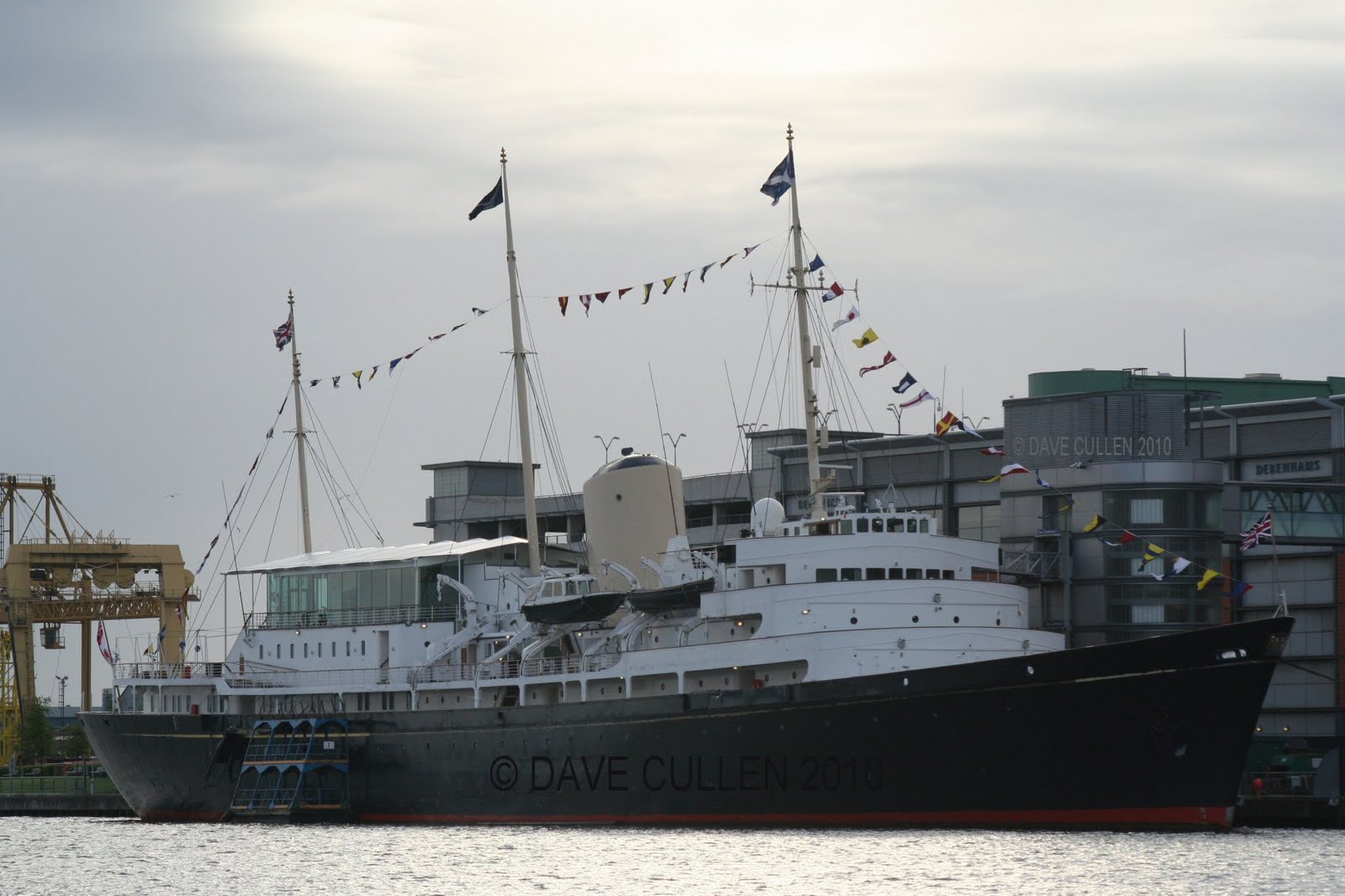
Some more images of the former Royal Yacht Britannia...

Note the new cafe situated on what was her viewing deck.