Total Pageviews

Copyright Theft

Copyright

All photographs are copyrighted.

Please do not copy or re-use without my WRITTEN permission.

Images published without consent is not permitted. I will procceed with court action on Copyright theft.

Copies maybe obtained upon request.

warshipsandauxiliares@yahoo.co.uk

Thank you

Tuesday, 13 September 2011

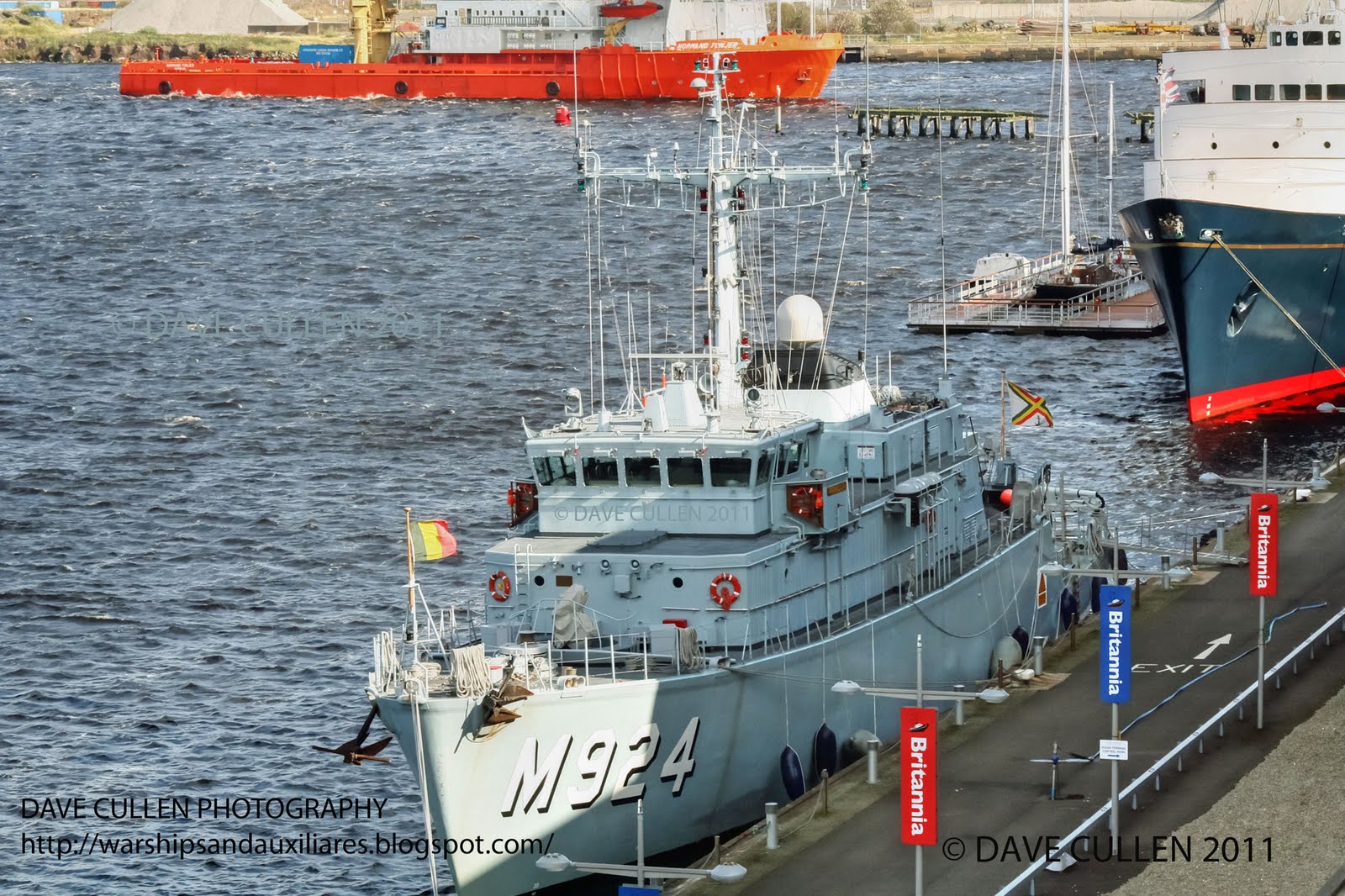
BNS Primula


Primula (M924) is a Tripartite-class mine hunter of the Belgian Naval Component, launched on December 20, 1990 at the Mercantile-Belyard shipyard in Rupelmonde and christened by Mrs. Adriaensens, the wife of the then Mayor of Willebroek, on June 12, 1991. The patronage of the Primula was accepted by the city of Willebroek. It was the tenth and last of the Belgian Tripartite-class mine hunters.

For more information on the Tripartite Class click HERE.

She is seen here in Leith she was meant to sail earlier on in the week but due to the bad weather her departure was delayed.


NATO Submarine Rescue System Submarine Rescue Vehicle

The NATO Submarine Rescue System (NSRS) is a multi-national project to develop an international submarine rescue system. The system will provide a rescue capability primarily to the partner nations of France, Norway and the UK but also to NATO and allied nations.

On receipt of a SUBSUNK alert the submarine operator will initiate the NSRS call-out procedure. The Intervention Remotely Operated Vehicle (IROV) will mobilise to the scene within 56 hours and locate the distressed submarine, establish communications, conduct damage assessment and prepare for rescue operations.

The SRV along with a portable launch and recovery system (PLARS), support and operating equipment and the Transfer Under Pressure (TUP) equipment will follow 6 hours later. All equipment and personnel will be flown to the mobilisation port for embarkation on a suitable mother ship (MOSHIP). The complete mobilisation will take less than 18 hours and the MOSHIP will then sail to the scene where the SRV will be deployed. The aim is to achieve time to first rescue of 72 hours, with personnel being brought to the surface in groups of 15 and transferring them to the TUP system if necessary.

The SRV is a manned submersible and was developed from previous rescue vehicles, notably LR5, developed by Perry Slingsby Systems Ltd in Yorkshire. It is 10m long, weighs 27 tonnes and has an all-steel, single piece hull.

The craft is operated by a three man crew (a pilot, an observer and a rescue chamber operator). It can operate at depths between 20m and 610m and can mate with the rescue hatch seal at angles of up to 60 degrees in any direction. It also uses the latest technology batteries, the Rolls Royce "Zebra" type.  This enable her to stay submerged for up to 96 hours.

SRV1 became available in 2005 and is planned to last to 2030, and cost £120 million to procure

The NSRS is based at HM Naval Base Clyde in Scotland.  

The submarine rescue ship Belos (A 214) acts as tender and transport to Submarine Rescue Vehicle (SRV1).

She is seen here over the stern of the Belos


HMS Belos

HMS Belos (ex–Energy Supporter) is a submarine rescue ship in the Swedish Navy's 1st Submarine flotilla. She carries Sjöugglan, Argus, Mantis and URF. She is also capable of carrying the British SRV1.

Originally built as a diving platform to serve offshore oil platforms, she was bought and converted to a submarine rescue ship. HMS Belos is the largest ship (by displacement) in the Swedish Navy.

Former oilfield supply, firefighting, and diver maintenance support vessel purchased March 1992 from Italian company S.A.N.A. and refitted at Rio de Janeiro before proceeding to Sweden and commissioning October 1992.  Belos has medical and berthing facilities for 35 rescued submariners.

A Mantis 1-man tethered submersible, handled by an A-frame crane to starboard, is used to reconnoiter bottomed submarines and has a 760-m max. depth; the Mantis can also be used as a remotely operated vehicle. The ship also carries a 3-man diving bell capable of operating in depths up to 1,500 m and a divers’ “wet bell” usable to 60-m depths and Sea Owl remotely operated submersibles. There are a 6-man and an 8-man decompression chambers for divers and a 35-man hyperbaric chamber for rescued submariners.
note also helicopter platform at the bow.

She is seen here in Leith (Note the SRV1 on the stern):


A couple of the SRV1 for more info on her click HERE

Friday, 9 September 2011

HrMs Snellius

Seen here in Leith is the lead ship of two HrMs Snellius alongside and departing Leith on Sunday 4th September 2011.  The ship is a hydrographic survey vessel built in both the Netherlands and in Romania.  She has a permanent crew of 12 & 6 hydrographers but can accommodate up to 42 persons.

Intended to replace Tydeman (A906) and Buyskes (A904).  Reportedly each ship has three crews to permit continuous operations.  The ships are seen in home waters and in the Netherlands Antilles and also do coast guard and surveillance duties

HrMs Snellius is seen here leaving Leith on Sunday 4th September 2011


With assistance from the tugs Roseberry Cross and Seal Carr


Tuesday, 23 August 2011

USS CARR

The Oliver Hazard Perry Class Frigate USS Carr is seen here arriving in Leith on Monday 22nd August 2011.

For more info on the Perry Class click HERE

Forth Ports tug Oxcar escort the frigate thru the channel:


USS Carr approaching Leith


Oxcar safely showing Carr the way


Almost in the lock


Almost on the berth with a little assistance from Fidra


A close up of the other Forth Ports tug Fidra


USS Carr's motto "Facta Non Verba" which roughly translated means Deeds Not Words

HMS Queen Elizabeth - well almost!

The largest section of the Navy's new aircraft carrier HMS Queen Elizabeth has safely arrived in Rosyth after being towed around Scotland.

This 8,000-tonne segment – Lower Block 03 to give it its official title – of the ship was towed 600 miles around the Scottish coast from one great artery, the Clyde, to another, the Forth, during a five-day operation. It safely arrived early on Saturday 20th August. (Nearly 4 hours late!)

 This section is more than 20 metres (65ft) high, 60 metres (196ft) long and 40 metres (131ft) wide. In addition to machinery spaces, it contains cabins for more than 150 members of the ship’s company and part of the vast hangar.

One of the largest cranes in the UK – its span is 120m (393ft) and it’s 68m (223ft) to the underside of the main beam – Goliath has been assembled in Rosyth to move sections of Queen Elizabeth and Prince of Wales weighing up to 1,000 tonnes each. It’s due to be ready to start work next month.

She is seen here arriving on Saturday evening:

Firstyl being escorted up the river by the tug Eraclea


Approaching the Forth Rail Bridge


Nearly there, wonder how long it will be before this re-appears from the dockyard