Total Pageviews

Copyright Theft

Copyright

All photographs are copyrighted.

Please do not copy or re-use without my WRITTEN permission.

Images published without consent is not permitted. I will procceed with court action on Copyright theft.

Copies maybe obtained upon request.

warshipsandauxiliares@yahoo.co.uk

Thank you

Tuesday, 24 August 2010

Oliver Hazard Perry Class Frigate

The Oliver Hazard Perry class is a class of frigates named after the American Commodore Oliver Hazard Perry, the hero of the naval Battle of Lake Erie. Also known as the Perry or FFG-7 class, the warships were designed in the United States in the mid-1970s as general-purpose escort vessels inexpensive enough to be bought in large quantities to replace World War II-era destroyers. They operated in an anti-submarine role to protect amphibious landing forces, supply and replenishment groups, and merchant convoys. Fifty-five ships were built in the United States: 51 for the United States Navy and four for the Royal Australian Navy (RAN). In addition, eight were built in the Republic of China (Taiwan), six in Spain, and two in Australia for their navies. Former U.S. Navy warships of this class have been sold or donated to the navies of Bahrain, Egypt, Poland, and Turkey.

Design and Construction

The ships were designed by the Bath Iron Works shipyard in Maine in partnership with the New York-based naval architects Gibbs & Cox.

The Oliver Hazard Perry-class ships were produced in 445-foot (136 meter) long "short-hull" (Flight I) and 453-foot (138 meter) long "long-hull" (Flight III) variants. The long-hull ships (FFG 8, 28, 29, 32, 33, and 36-61) carry the larger SH-60 Seahawk LAMPS III helicopters, while the short-hulled warships carry the smaller and less-capable SH-2 Seasprite LAMPS I. Aside from the lengths of their hulls, the principal difference between the versions is the location of the aft capstan: on long-hull ships, it sits a step below the level of the flight deck in order to provide clearance for the tail rotor of the longer Seahawk helicopters. The long-hull ships also carry the RAST (Recovery Assist Securing and Traversing) system for the Seahawk, a hook, cable, and winch system that can reel in a Seahawk from a hovering flight, expanding the ship's pitch-and-roll range in which flight operations are permitted. The FFG 8, 29, 32, and 33 were built as "short-hull" warships but were later modified into "long-hull" warships.

American shipyards constructed Oliver Hazard Perry-class ships for the U.S. Navy and the Royal Australian Navy (RAN). Early American-built Australian ships were originally built as the "short-hull" version, but they were modified during the 1980s to the "long-hull" design. Shipyards in Australia, Spain, and the Republic of China have produced several warships of the "long-hull" design for their navies.
Although the per-ship costs rose greatly over the period of production, all 51 ships planned for the U.S. Navy were built. Some Oliver Hazard Perry-class warships are planned to remain in American service for years, but some of the older ships have been decommissioned and some scrapped. Others of these decommissioned ships have been transferred to the navies of other countries, including Bahrain, Egypt, Poland, and Turkey. Several of these have replaced old Second World War-built American destroyers that had been given to those countries.

During the design phase of the Oliver Hazard Perry class, head of the Royal Corps of Naval Constructors, R.J. Daniels, was invited by an old friend, US Chief of the Bureau of Ships, Adm Robert C Gooding, to advise upon the use of variable-pitch propellers in the class. During the course of this conversation, Daniels warned Gooding against the use of aluminium in the superstructure of the FFG-7 class as he believed it would lead to structural weaknesses. A number of ships subsequently developed structural cracks, including a 40 ft fissure in USS Duncan, before the problems were remedied.

The Oliver Hazard Perry-class frigates were designed primarily as anti-aircraft and anti-submarine warfare guided-missile warships intended to provide open-ocean escort of amphibious warfare ships and merchant ship convoys in moderate threat environments in a potential war with the Soviet Union and the Warsaw Pact countries. They could also provide air defense against 1970s- and 1980s-era aircraft and anti-ship missiles. These warships are equipped to escort and protect aircraft carrier battle groups, amphibious landing groups, underway replenishment groups, and merchant ship convoys. They can conduct independent operations to perform such tasks as surveillance of illegal drug smugglers, maritime interception operations, and exercises with other nations.

The addition of the Naval Tactical Display System, LAMPS helicopters, and the Tactical Towed Array System (TACTAS) gave these warships a combat capability far beyond the original expectations. They are well-suited for the littoral regions and most war-at-sea scenarios.

Notable combat actions

Oliver Hazard Perry-class frigates made worldwide news twice during the 1980s. Despite being small, these frigates were shown to be extremely durable. During the Iran–Iraq War, on 17 May 1987, the USS Stark was nearly sunk by an Iranian mine. No lives were lost, but 10 sailors were evacuated from the warship for medical treatment. The U.S. Navy retaliated four days later with Operation Praying Mantis, a one-day attack on Iranian oil platforms being used as bases for raids on merchant shipping. Those had included bases for the minelaying operations that damaged the USS Samuel B. Roberts. Both frigates were repaired in American shipyards and returned to full service. The USS Stark was decommissioned in 1999, and scrapped in 2006. was attacked by an Iraqi warplane. Struck by two Exocet anti-ship missiles, thirty-seven American sailors died in the deadly prelude to the American Operation Earnest Will, the reflagging and escorting of oil tankers through the Persian Gulf and the Straits of Hormuz. Less than a year later, on 14 April 1988, the USS

Modifications

United States
The U.S. Navy is modifying its remaining Perrys to reduce their operating costs, replacing Detroit Diesel Company electrical generators with Caterpillar, Inc.-made diesel engines. 

In mid-2000, the Navy removed the frigates' Mk 13 single-arm missile launchers and magazines because the primary missile, the Standard SM-1MR, became outmoded.

The "zone-defense" anti-aircraft warfare (AAW) capability has vanished, and all that remains is a "point-defense" type of AAW armament. It would supposedly have been too costly to refit the Standard Missile SM-1MR missiles, which had little ability to bring down sea-skimming missiles. Another reason is to allow more SM-1MRs to go to American allies that operate Perrys, such as Poland, Spain, Australia, Turkey, and the Republic of China (Taiwan).

The loss of the launchers also strips the frigates of their Harpoon anti-ship missiles. However, their Seahawk helicopters can carry the much shorter-range Penguin anti-ship missile.

The U.S. Navy plans to update the Oliver Hazard Perry-class warships' Phalanx CIWS to the "Block 1B" capability, which will allow the Mk 15 20 mm Phalanx gun to shoot at fast-moving surface craft and helicopters. The remaining Oliver Hazard Perry-class ships are also to be fitted with the Mk 53 DLS "Nulka" missile decoy system, which will be better than the presently-equipped chaff (SRBOC, Super Rapid Blooming Offboard Chaff) and flares at guarding against anti-ship missiles.

On June 16, 2009, Vice Adm. Barry McCullough turned down the suggestion of Rep. Mel Martinez to keep the Perrys in service, citing their worn-out and maxed-out condition.  However, Reps. Ander Crenshaw and Gene Taylor have taken up the cause.

Australia

Australia is spending one billion Australian dollars to upgrade Royal Australian Navy (RAN) Adelaide-classguided-missile frigates, including equipping them to fire the SM-2 version of the Standard missile, adding an eight-cell Mk-41 vertical launch system for Evolved Sea Sparrow missiles, and installing better air-search radars and long-range sonar.

The first of the upgraded frigates, HMAS Sydney, returned to the RAN fleet in 2005. Each of the four frigates to be upgraded have the work at the Garden Island shipyard in Sydney, Australia, with the modernizations lasting between 18 months and two years. These frigates are planned to be replaced starting in 2013 by three new Hobart-class air warfare destroyers equipped with the AEGIS combat system. However, the third of those destroyers will not be commissioned until 2017, at the earliest.

The cost will be partly offset, in the short run, by the decommissioning and disposal of the two older frigates. HMAS Canberra was decommissioned on 12 November 2005 at naval base HMAS Stirling in Western Australia and HMAS Adelaide was decommissioned at that same naval base on 20 January 2008.

Turkey

The Turkish Navy has commenced the modernization of its G class frigates with the GENESIS (Gemi Entegre Savaş İdare Sistemi) combat management system.  The first GENESIS upgraded ship was delivered in 2007, and the last delivery is scheduled for 2011.  The "short-hull" Oliver Hazard Perry-class frigates that are currently part of the Turkish Navy were modified with the ASIST landing platform system at the Gölcük S-70B Seahawk helicopters. Turkey is planning to add one eight-cell Mk 41 Vertical Launching Systems (VLS) for the Evolved Sea Sparrow missile, to be installed forward of the present Mk 13 missile launchers, similar to the case in the modernization program of the Australian Adelaide class frigates.  There are also plans for new components to be installed that are being developed for the Milgem class warships ( Naval Shipyard, so that they can accommodate the Ada class corvettes and F-100 class frigates) of the Turkish Navy. These include modern Three-dimensional and X-band radars developed by Aselsan and Turkish-made hull-mounted sonars. One of the G class frigates will also be used as a test-bed for Turkey's 4,500-ton TF-2000 class anti-aircraft warfare (AAW) frigates that are currently being designed by the Turkish Naval Institute.

Ships of the class

Shhip Name Hull No


US Built
Oliver Hazard Perry FFG-7
McInerney FFG-8
Wadsworth FFG-9
Duncan FFG-10
Clark FFG-11
George Philip FFG-12
Samuel Eliot Morison FFG-13
Sides FFG-14
Estocin FFG-15
Clifton Sprague FFG-16
Built for Australia as HMAS Adelaide (FFG 01) FFG-17
Built for Australia as HMAS Canberra (FFG 02) FFG-18
John A. Moore FFG-19
Antrim FFG-20
Flatley FFG-21
Fahrion FFG-22
Lewis B. Puller FFG-23
Jack Williams FFG-24
Copeland FFG-25
Gallery FFG-26
Mahlon S. Tisdale FFG-27
Boone FFG-28
Stephen W. Groves FFG-29
Reid FFG-30
Stark FFG-31
John L. Hall FFG-32
Jarrett FFG-33
Aubrey Fitch FFG-34
Built for Australia as HMAS Sydney (FFG 03) FFG-35
Underwood FFG-36
Crommelin FFG-37
Curts FFG-38
Doyle FFG-39
Halyburton FFG-40
McClusky FFG-41
Klakring FFG-42
Thach FFG-43
Built for Australia as HMAS Darwin (FFG 04) FFG-44
De Wert FFG-45
Rentz FFG-46
Nicholas FFG-47
Vandegrift FFG-48
Robert G. Bradley FFG-49
Taylor FFG-50
Gary FFG-51
Carr FFG-52
Hawes FFG-53
Ford FFG-54
Elrod FFG-55
Simpson FFG-56
Reuben James FFG-57
Samuel B. Roberts FFG-58
Kauffman FFG-59
Rodney M. Davis FFG-60
Ingraham FFG-61


Australian Built
HMAS Sydney FFG 03
HMAS Darwin FFG 04
HMAS Melbourne FFG 05
HMAS Newcastle FFG 06


Spanish Built
SPS Santa María F81
SPS Victoria F82
SPS Numancia F83
SPS Reina Sofía F84
SPS Navarra F85
SPS Canarias F86


Republic of China Built (Taiwanese)
ROCS Cheng Kung FFG-1101
ROCS Cheng Ho FFG-1103
ROCS Chi Kuang FFG-1105
ROCS Yueh Fei FFG-1106
ROCS Tzu I FFG-1107
ROCS Pan Chao FFG-1108
ROCS Chang Chien FFG-1109
ROCS Tian Dan FFG-1110

USS Underwood (FFG 36) is seen here departing Faslane


USS Doyle (FFG 36) arriving Leith 11th September - Note the large Stars and Stripes flag


USS Klakring (FFG 42) alongside HMS Edinburgh in Leith


USS Taylor (FFG 50) on the outside of USS Doyle (FFG 36) at Faslane


Seen here departing Faslane


Monday, 23 August 2010

ORP Generał Kazimierz Pułaski

ORP Generał Kazimierz Pułaski (Pendant 272) is one of two Oliver Hazard Perry class guided-missile frigates in the Polish Navy. Formerly serving in the United States Navy as USS Clark (FFG-11), after her transfer to Poland she was named for Kazimierz Pulaski, an American Revolutionary War hero in the United States and an independence hero in Poland.

The Clark was decommissioned and stricken on 15 March 2000. That same day, she was transferred to Poland. She is propelled by two General Electric LM-2500 gas turbines and two 350 horsepower (261 kW) electric drive auxiliary propulsion units.

She was renamed on 25 June 2000 in a ceremony attended by Madeleine Albright. Commander Marian Ambroziak was the first Polish Commanding Officer. Generał Kazimierz Pułaski is homeported in Gdynia (Oksywie), and has participated in numerous NATO exercises in the Baltic. 

She is seen here sailing from Faslane

G Class frigate

The G class (Turkish: Gabya sınıfı fırkateyn(ler)) is one of the frigate classes of the Turkish Navy. They are extensively modernized versions of ex-Oliver Hazard Perry class guided-missile frigates, mainly designed for air defense with a weapons configuration that is optimized for general warfare.

Upgrades
The G class frigates have undergone a major modernization program which included the retrofitting of a Turkish digital combat management system named GENESIS (Gemi Entegre Savaş İdare Sistemi). The first GENESIS upgraded ship was delivered in 2007, and the last delivery is scheduled for 2011. The GENESIS advanced combat management system includes the following characteristics and abilities:

A modern and reliable system
High performance
Open architecture
Capacity of tracking more than 1,000 tactical targets
Modern digital sensor data fusion
Automatic threat evaluation
Weapon engagement opportunities
Link-16/22 system integration


The Mk-41 VLS will be fitted in front of the Mk.13 launchers, similar to their installation on the Adelaide-class frigates of the Royal Australian Navy, which are Australian-built derivatives of the Oliver Hazard Perry class frigates.

The "short hull" ex-Perry class frigates that are currently being operated by the Turkish Navy were modified with the ASIST landing platform system at the Istanbul Naval Shipyard, so that they can accommodate the S-70B Seahawk helicopter.

Ships of the class
  
TCG Gaziantep (F 490) (ex-USS Clifton Sprague (FFG-16)) 
TCG Giresun (F 491) (ex-USS Antrim (FFG-20)) 
TCG Gemlik (F 492) (ex-USS Flatley (FFG-21)) 
TCG Gelibolu (F 493) (ex-USS Reid (FFG-30)) 
TCG Gökçeada (F 494) (ex-USS Mahlon S. Tisdale (FFG-27)) 
TCG Gediz (F 495) (ex-USS John A. Moore (FFG-19)) 
TCG Gökova (F 496) (ex-USS Samuel Eliot Morison (FFG-13)) 
TCG Göksu (F 497) (ex-USS Estocin (FFG-15))

Gediz  is seen here leaving Faslane


Baleares Class Frigate

The Baleares class were a group of five frigates built for the Spanish navy in the 1970s. The ships are a modified version of the American Knox class frigates. The key differences are the replacement of the Sea Sparrow PDMS and ASW helicopter facilities by Standard SAM and associated radars. They received a SPS-52B 3D search radar and one SPG-51 illuminator for the Standard SM-1 medium range SAM, fired from a Mk22 16 round single arm launcher. The SQS-26 long range LF sonar was replaced by a SQS-23G MF sonar, while two Mk25 tubes for Mk37 torpedoes we mounted in the tramson. The SQS-35 variable depth sonar was maintained.

The five ships were upgraded several times during their service lives. They received a Spanish TRITAN combat data system and the EW suite was upgraded with Spanish equipment. Mk36 SROC decoy launchers were also added, as well as two quadruple Harpoon launchers amidships. Two Meroka CIWS gun system were also fitted. The old SQS-23G sonar was replaced by a modern DE-1160LF set built in Spain (a larger, lower frequecy version of the SQS-56 sonar) and the Mk25 tubes were dismounted to allow for female crewmember berthing.

The Ships have recently been retired, in order to assume the F-100 frigates costs .
 
Ships of the class
F71 Baleares 1970 - 2004
F72 Andalucia 1971 - 2005
F73 Cataluna 1971 - 2004
F74 Asturias  1972 - 2009
F75 Extremadura 1972 - 2006

Andalucia is seen here alongside in Leith


Santa Maria Class Frigates

SPS Navarra (F85) is the fifth of the six Spanish-built Santa Maria-class frigates, based on the American Oliver Hazard Perry class design, of the Spanish Navy.

Laid down on April 15, 1991, and launched on October 23, 1992, Navarra was commissioned in service on May 27, 1994.

The ship features a series of improvements to her previous sisters, with a new Meroka mod 2B CIWS, and upgraded fire control systems with Mk.92 mod6 CORT (Coherent Receiver Transmitter) and SPS-49(v)5 radar instead of previous (v)4.
All of these Spanish frigates have the length of the later Oliver Hazard Perry frigates, and have a wider beam than the US Navy design, and therefore able to carry more top weight. Fin stabilizers are fitted.

On December 9, 2002, Navarra intercepted the unflagged freighter So San several hundred miles southeast of Yemen at the request of the United States government as part of Operation Enduring Freedom - Horn of Africa. The frigate fired across the So San's bow after the freighter ignored hails and attempted to evade the frigate. The freighter's crew was North Korean; 23 containers containing 15 complete Scud ballistic missiles, 15 high-explosive warheads, and 23 nitric acid containers were found on board. Yemen claimed ownership of the shipment and protested the interception and U.S. officials released the vessel after receiving assurances that the missiles would not be transferred to a third party. On 23 March 2010, she sank a Somali pirate mothership lifeboat and captured two skiffs, after private security forces successfully defended the MV Almezaan from a pirate attack. The six suspected pirates were later released, when the master and crew of the Almezaan refused to testify.

Ships of the class 

F81 Santa Maria
F82 Victoria
F83 Numancia
F84 Reina Sofia
F85 Navarra
F86 Canarias

Sps Navarra is seen here departing Faslane


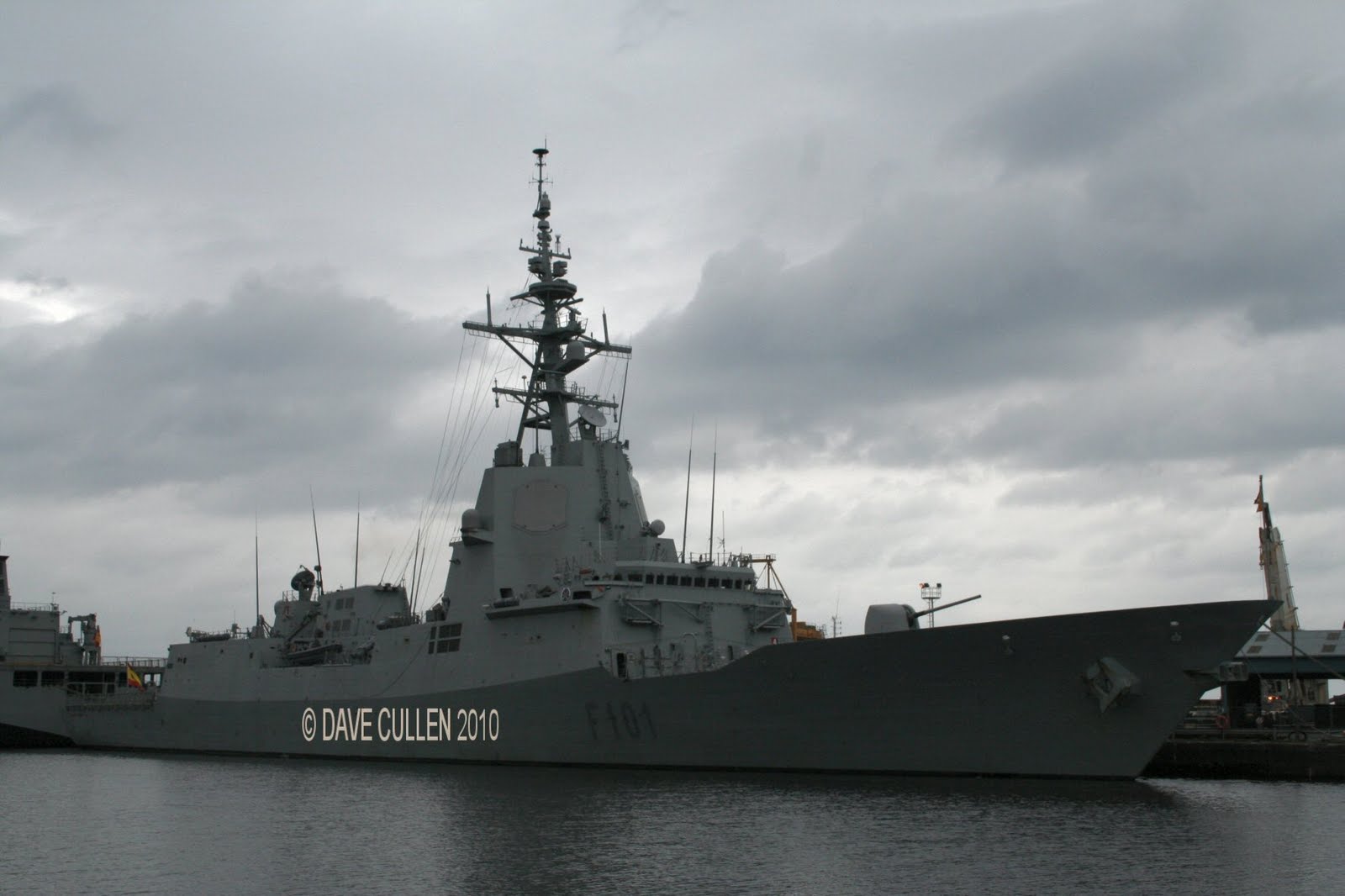
Álvaro De Bazán Class Frigates

The Álvaro de Bazán class (also known as the F100 class of frigates) are a new class of Aegis combat system-equipped air defense frigates entering service with the Spanish Navy. They are being built in the Spanish factory of Ferrol and are named after Admiral Álvaro de Bazán.

The ships utilize American Aegis weapons technology allowing them to track hundreds of airborne targets simultaneously as part of its air defense network. The F100 Alvaro de Bazan class multirole frigate is one of the few non-US warships to carry the Aegis Combat System and its associated AN/SPY-1 radar. (Japan's Kongo class and the F100-derived Norwegian Fridtjof Nansen class of frigates also use the Aegis system.)
The F100 will be the basis of the Australian Hobart class destroyer (previously known as the "Air Warfare Destroyer"). The Australian government announced in June 2007 that, in partnership with Navantia, three F100 vessels will be built for the Royal Australian Navy with the first due for delivery in 2014.

Lockheed Martin, Navantia and the U.S. Navy are conducting final systems integration.

The Alvaro de Bazan class frigates are the first modern vessels of the Spanish Navy to incorporate ballistic resistant steel in the hull, along with the power plants being mounted on anti-vibration mounts, reducing the noise and making them less detectable by submarines.

Ships of the class (year entered service)

F101 Álvaro de Bazán (2002)
F102 Almirante Juan de Borbón (2003)
F103 Blas de Lezo (2004)
F104 Mendez-Nuñez (2006)
F105 Cristobal Colón (2011)
F106 Juan de Austria  (2012)

Operational History

In late 2005, Álvaro de Bazán was deployed as part of the USS Theodore Roosevelt aircraft carrier battle group in the Persian Gulf. This was the first deployment of a Spanish warship as part of an American naval battle group.

In early March 2007, the Álvaro de Bazán was the first Spanish Naval Vessel to visit Australia in 150 years. The ship made several port visits around Australia in conjunction with the Spanish Naval ship builder Navantia's bid to design the Royal Australian Navy's new Air Warfare Destroyer. The ship was also visiting Australia as part of the first circumnavigation of the globe by a Spanish warship in 142 years.

Álvaro de Bazán is seen here alongside in Leith
Seen here with the Spanish naval tanker Patiño

RFA Lyme Bay

RFA Lyme Bay (L3007) is a Bay class auxiliary landing ship dock (LSD(A)) of the British Royal Fleet Auxiliary.

Lyme Bay was built by Swan Hunter at Wallsend on the River Tyne, being the last ship built on the river. On July 13, 2006 it was announced that, due to delays and cost over-runs, fitting out of Lyme Bay would be transferred from Swan Hunter and completed by BAE Systems at Scotstoun. Lyme Bay arrived on the River Clyde on July 22, 2006.

RFA Lyme Bay is seen here fitting out at Scotstoun


Vasco Da Gama Class Frigate

Named in honor of the great Portuguese explorer Vasco da Gama, the Vasco da Gama class is a class of frigates of the MEKO 200 PN German concept. They are the major surface ships of the Portuguese Navy. Portugal operates three ships of this class, which were built in Kiel by Blohm + Voss and later by HDW, using modular construction techniques.

The project for the construction of three frigates of this class was authorized by the Portuguese Government in 1985, five years after the request of the Portuguese Navy for the acquisition of new surface ships. According to Conway's, 60% of the funding for these ships came from NATO military aid. Similar ships have been built for the navies of Greece, Turkey, Australia and New Zealand.

Ships of the class
F330  Vasco Da Gamma
F331  Alvares Cabral
F332  Corte Real

Alvares Cabral is seen here arriving Leith


Knm Vidar

Knm Vidar (N52) was a Royal Norwegian Navy minelayer and command vessel. Vidar was built by Mjellem & Karlsen in Bergen in 1977. 

Her sistership is Knm Vale, which was given to Latvia in 2003. Vidar is named after Odin's son Vidar from Norse mythology. The vessel was the command ship for MCMFORNORTH in 2004 and 2005. In 2006 she was sold to Lithuania and given the name Jotvingis. The Lithuanian Navy uses her as a command and support ship. 

Ship specifications
  • Crew: 61
  • Length: 64.8 m
  • Displacement: 1750 tons
  • Speed: 14.8 knots
  • Armament: 2x 40 mm Bofors guns, 2x12.7 mm machine gun, 1x Mistral surface-to-air missile
Knm Vidar is seen arriving in Leith


She is seen here sailing down the Clyde a few days previously


Ula Class Submarines

The Ula class is a Norwegian submarine type which was assembled in Germany in the late 1980s and early 1990s. The class, consisting of 6 vessels, is currently the only submarine type in service with the Royal Norwegian Navy.

The ordering of a new Norwegian submersible design stemmed from a 1972 decision to modernize the Royal Norwegian Navy (RNoN) submarine flotilla, which then consisted of the aging Kobben class submarines.
The construction of the vessels was an international project. The combat systems were made in Norway by Kongsberg, the attack sonar is German and the flank sonars French. The hull sections were produced in Norway, and then assembled in Germany by Thyssen Nordseewerke, Emden. In Germany, the design is known as the U-Boot-Klasse 210.

When commissioned Ulas were the first Norwegian submarines with bedding for the entire crew and a shower.

The Ula class submarines are among the most silent and maneuverable submarines in the world. This, in combination with the relatively small size, makes them difficult to detect from surface vessels and ideal for operations in coastal areas. The Ula class submarines are regarded as both the most effective and cost-effective weapons in the RNoN.

Missions
In recent years, several submarines of the Ula class have been deployed in the Mediterranean Sea in support of the NATO Operation Active Endeavour, where their intelligence gathering ability have surpassed expectations. Their operational availability proved to be the highest of all the ships taking part in the operation. However, this deployment has highlighted the need to make the Ula class submarines better able to keep temperatures from getting too high for the crew when operating in warm waters. As a response to this, the Knm Ula have now been "tropicalized" by installing new cooling systems, and two more of the class are due for "tropicalisation".

Future plans
During the period 2006-2008, the Ula class will be modernized. Most notably, the submarines will get new communication equipment, new electronic warfare support measures and a periscope upgrade.  In May 2008, the contract for new sonars was signed. The first submarine will have new sonar in 21 months time, and the last in 52 months. The Ula class will probably be kept in service until 2020.

Ships of the class
Six submarines were delivered (1989-1992) to the RNoN. All of them have their home base at Haakonsvern Bergen. The boats are all named after places in Norway, with the exception of the S305, Uredd, which literally translates to "unafraid". The ship prefix for RNoN vessels is KNM (Kongelig Norsk Marine, Royal Norwegian Navy) 
  
Vessel list
S300  Knm Ula      
S301  Knm Utsira  
S302  Knm Utstein 
S303  Knm Utvaer  
S304  Knm Uthaug   

Knm  Utstein sailing from Faslane


Arriving Leith
Sailing from Leith, passing Inchkeith Island

Oksøy & Alta Class Mine Hunter - Mine Sweepers

The Oksøy-class mine hunters are a class of vessels of the Royal Norwegian Navy active since the mid-1990s.
Almost identical to the Alta class, the only differences are the equipment on the aft deck and aft 1. deck, the sonars (two instead of one), and the length of the superstructure on 1. deck. The minehunters carry two ROV's, and when in active service a few highly trained divers, with competence in mine clearing. While the minesweepers have only one rigid inflatable boat, the Oksøy-class carries two, one for the divers and one for other purposes.

The Alta class minesweeper is a ship class of minesweepers operated by the Royal Norwegian Navy. An almost identical class of minehunters is known as the Oksøy class.
The Alta class was built by Kvaerner Mandal during 1996 and 1997, while the related Oksøy class was built in 1994 and 1995. A total of 9 vessels were built, 5 minesweepers and 4 minehunters. Knm Orkla was completely destroyed in a fire, and Knm Oksøy was damaged when it ran aground in 2005. The pair, along with Knm Glomma, are no longer in active service. The catamaran hull is built in a fibre-reinforced plastic sandwich of very low magnetic signature.

Two large fans located on each side create an air cushion between the two hulls and a front and aft rubber skirt, lifting the vessel, giving small drag and a high cruise speed, as well as low susceptibility to the shock of exploding mines since only a small portion of the hull is actually exposed in the water. Propulsion by water jet, again one in each hull, gives a low acoustic signature. A degaussing system gives the vessels extremely low electromagnetic signature.

Knm Hinnoy is seen here arriving Leith


Seen here sailing down the Clyde a few days earlier